EV Rescue Charging 101

A new way to get more calls: what it is, what it takes and how to price it

What is EV rescue charging? EV rescue charging means bringing a portable Level 2 charger to a stranded electric vehicle and adding about 5–10 miles of range in roughly 20 minutes, enough to reach the next charger. This page is the full web version of the EV Rescue Charging 101 seminar Ron gives tow operators: what it is, what equipment it takes, how to price a call and how to get the calls.

Last reviewed: November 20, 2026

Before we start

  • Education only. Not legal, tax, financial, electrical or safety advice. Check your state and local rules, licensing and insurance before offering rescue charging. Follow all applicable laws.
  • No earnings promise. Prices, call volumes and payback numbers are examples or individual reports. Your results depend on your market, costs and effort.
  • Results vary. Charging speed and range depend on the vehicle, its battery, weather and more. Follow the vehicle and equipment instructions. Our unit runs outdoors only.
  • Estimates. Market figures are EVroadHERO estimates. Vehicle figures are manufacturer and EPA estimates. Current as of the Last reviewed date above and subject to change.
  • Other companies. Names and trademarks belong to their owners and are used only to identify them; no endorsement implied. EVroadHERO has a business relationship with EEErescue.com.
  • Our terms apply. EVroadHERO units are sold under our written terms of sale and limited warranty (full terms at EVroadHERO.com/terms). Not sold for use in California.
  • Follow the manuals. Read and follow all manuals, specifications and instructions for every vehicle and piece of equipment mentioned, including ours.
  • Our opinions. Ideas and recommendations here are the opinions of Ron Sledzieski and EVroadHERO, based on our experience. They are not statements of fact or guarantees.

More guides, FAQs and this material: EVroadHERO.com/education

A rescue charge, start to finish

Five steps from the phone ringing to the driver rolling again.

  1. The callA stranded EV driver calls you. (How to get more of these calls comes later.)
  2. The questionsWhere are you? How far to a charger? What EV? Precondition the battery if you can, turn off your heat or AC. I’m on my way.
  3. Arrive and agreeExplain the plan and take a card: a plug fee plus an electricity fee, like a hook fee and a mileage fee.
  4. Plug in, 20 minutesTypically 5–10 rescue miles. Offer another session, for a fee, if they need more.
  5. Back on the roadEnd the charge, unplug, and everyone is on their way.

The unit always runs outdoors, never inside a vehicle.

Two kinds of mobile EV charging

They are two different jobs, with two different business models.

OUR FOCUS

Rescue charging

Like bringing a 1/2 gallon of gas.

  • 5–10 miles to reach the nearest charger, typically provided in under 30 minutes
  • Strong business model: about the price of a tow, meets an urgent need
  • Smaller, lower-cost equipment, higher price per call = faster payback
A DIFFERENT BUSINESS

Convenience charging

Like a fill-up delivered.

  • Expectation to provide far more than 5–10 miles, “charging as a service” for busy EV owners to avoid the charger themselves
  • Weaker business model: just above the cost of a charge, for a non-urgent need*
  • Larger, costly DC equipment, lower price per call = slower payback

*Other, more compelling cases may exist for fleet charging.

More: Rescue vs. Convenience Charging →

Two numbers explain it all

kW — Speed: how fast it flows

The charger’s power. Like how fast fuel comes out of a pump nozzle.

240 volts × 37 amps ≈ 9 kW. Charging at this rate* for an hour provides 9 kWh of energy.

kWh — Energy: the fuel itself

Like gallons. Battery capacity (tank size) is in kWh: about 60 to over 100.

An average EV gets 3.5 miles per kWh, so 9 kWh of energy provides just over 30 miles.

⚠ *Watch out for “up to 1 mile per minute” claims. An EV near 0% protects its battery and typically won’t charge at full speed right away. Results vary.
More: Mobile EV Charging Basics →

EV fuel efficiency

Chevy Bolt

65 kWh · 262 mi · 3.6 mi/kWh avg

Tesla Model 3

~75 kWh · 363 mi · 4.0 mi/kWh avg

Hummer EV

~200 kWh · ~315 mi · 1.5 mi/kWh avg

Other EVs

Other EVs: battery size, range, average miles per kWh and a 70% convenience charge
Other EVsBatteryRangeAvg mi/kWh70% convenience charge
Chevy Equinox EV FWD85 kWh319 mi3.2~60 kWh
Tesla Model Y LR AWD~75 kWh311 mi3.4~53 kWh
Rivian R1T Dual Max~140 kWh420 mi2.6~98 kWh
Rules of thumb
  • Ask what EV it is.
  • Big trucks get about half the miles.
  • Cold, highway speed and low battery mean fewer miles.

Avg mi/kWh = EPA combined rating. 70% convenience charge = 70% of battery size. 2027 Bolt (no 2025 was made); others 2025 models. EPA and manufacturer estimates via fueleconomy.gov, GM, KBB and Edmunds. Real results vary.

Realistic speed

5–10 milesof range in about 20 minutes, with a 9 kW unit
15–30 milesof range per hour of charging
⚠ Beware “up to 1 mile per minute.” EVs near zero charge slowly at first. Results vary, better and worse, by model, weather and more.

Four considerations with mobile EV charging equipment

Speed

Level 2: about 20 minutes for 5–10 miles. Level 3 DC: much faster, much pricier.

Refilling

Gas-powered inverter: pour in fuel, back in minutes. DC battery units themselves need to be recharged.

Cost

Level 2 units: under $10K. Mobile DC: about $15K to $120K and up.

Portability

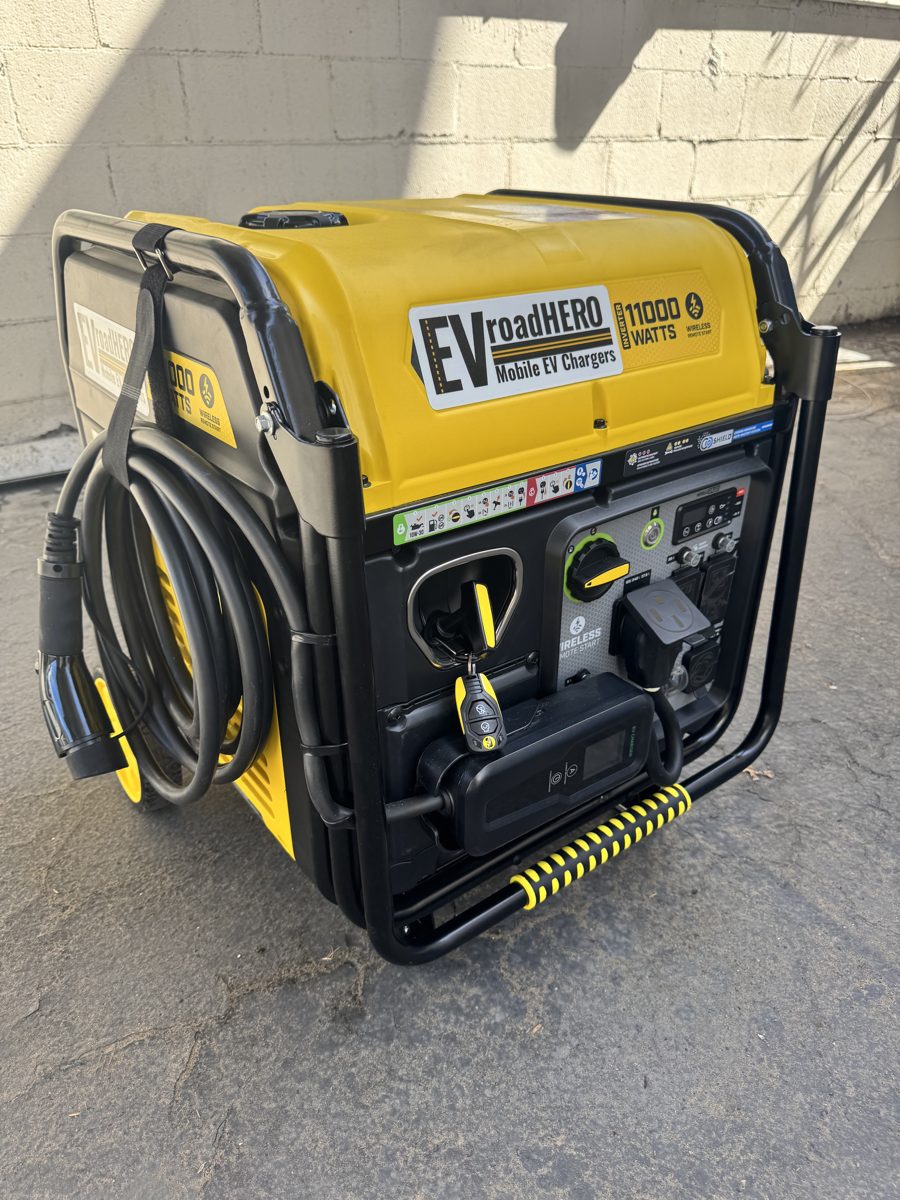
Ours: about 200 lb on wheels with a handle. Big DC units can fill an 8-foot pickup bed.

The EVroadHERO portable Level 2 rescue charger on wheels, three-quarter view

Equipment options side by side

Equipment options: unit and speed, approximate price, best use
Unit / speedApprox. priceBest for
9–11.5 kW Level 2$5,500–$7,000Rescue charging
30 kW DC$20K–$30KRescue, small top-ups
60 kW DC$60K–$70KRescue and convenience

Prices are approximate market ranges.

Don’t expect a squirt gun to fill a bathtub. A rescue charge gets them to a charger, not full.

The EV dictates the actual charging speed, regardless of the charger’s top speed.
DIY equipment? Yes, but get two things right:
  • 1. Clean power. Use an inverter, not a standard generator.
  • 2. Right size. Charger draw can’t exceed the inverter’s running watts.

EV Rescue Pricing: About that of a tow

OPTION 1 · PLUG FEE + ELECTRICITY FEE$100 + $50Plug fee covers the first 20 minutes, like a hook fee.Sell another 20 min: +$50
OPTION 2 · TRAVEL FEE + ONE HOUR$40 + $200Some drivers have enough before 1 hour.Stop early, still fully paid.
OPTION 3 · BY THE MINUTE$ per minuteDrivers watch the clock, and EVs start slowly.Not recommended.

In more detail

  • Option 1, plug fee plus electricity fee: $100 covers the first 20 minutes, like a hook fee. If they need more, sell a second 20-minute session: another electricity fee of, say, $50, like a mileage fee.
  • Option 2, travel fee plus one hour: $40 travel and $200 for the hour. In many cases the driver needs only part of that hour and asks you to stop the charge because they have enough and want to leave. They stop early, and you still get paid in full.
  • Option 3, by the minute: some do it, but we don’t recommend it. People get antsy watching the clock, and an EV near zero always starts charging slowly.

Price it like a tow, more if possible. Too high, and they may haggle, hang up or ask for a tow. They may have just priced one. They may already know the price of a tow, or just got off the phone with a tow provider.

If they push back, remind them a tow:

  • Takes longer. Waiting, hooking up, the drive.
  • Needs EV know-how. Not every tow provider knows how to tow an EV. Dollies, or even a flatbed if the car is dragged up onto it, can damage an EV.
  • Means riding in your truck. They don’t want to.

Examples only, not an earnings promise; before your own costs.

Get the calls: Road Clubs and Tow Networks

They need providers. They should want you.

Ask to join

  • Ask clubs and tow networks to list you. Call the ones near you and ask to be their EV rescue provider.
  • iTow is actively building its EV service.
  • Its app already has an EV option (an EV rescue checkbox), unlike many other road clubs.

No EV option in the app?

Check with the road club first. A few say that when taking the job in the app:

  • ✓ Check “Fuel delivery”* and note the EV rescue charge.
  • ✗ Never “Dead battery.” It pays much less than a tow, and an EV rescue should be priced and paid like a tow.

Or “out of network”: the driver skips the club’s tow, hires you directly and pays you, then sends your itemized receipt to their road club for reimbursement. Many clubs consider it, but it’s not guaranteed, and many pay only up to their usual rate. Take payment at the scene and give a proper itemized receipt.

*Several road clubs say this is OK until their apps add EV charging, which takes time. Check with each club you work with.

Road club tips: see the FAQ →

More ways to get the calls

EV dealers

Your card in every EV sold. You solve a problem and make EVs easier to sell.

National used-car lots

Traded-in EVs often arrive low on charge.

Fleets

Post Office, police, school buses, construction equipment. Who manages your town’s EV fleet?

Get scrappy

Signs at highway exits, lots, airports and charging stations. Go wherever you see EVs and hand out cards. At rental car agencies, skip the front desk and talk to the car cleaners.

Always be ethical and follow all laws.

And online: Google Ads and social media, like you already do for tows. EV rescue charging is easier to rank for.

More: how to get more calls, in the FAQ →

Get the calls: EEErescue.com

The key is to get leads flowing your way. EEErescue.com is building out a nationwide network, with more calls in big EV metros. Contact EEErescue.com for the latest information on how it works. EVroadHERO has a business relationship with EEErescue.com.

Don’t buy the equipment and hope the calls come. No calls yet? Have a plan and work it, or the equipment sits unused.

Quick Market Survey: an estimated $10M a year

U.S. OUT-OF-CHARGE EVs IN 2026~50,000About 137 a day.
ASSUMED PER RESCUE× $200An assumption, not a promise.
A YEAR, AND GROWING= ~$10MEVroadHERO estimate.

AAA reported EV charging in only 24 cities (TIME, 2023 data).1 Most markets are wide open.

YES, stranded EVs are real. It happens more than you might expect.

Source: EVroadHERO analytical estimate using AAA roadside-assistance statistics and EV-adoption projections. About 50,000 U.S. out-of-charge incidents are modeled for 2026. This is not an official AAA, TIME, EEI or ICF forecast, and the sources have not verified our assumptions. Provided for educational purposes only; actual results will vary.

  1. TIME, “The Main Reason EV Drivers Call AAA for Help Is Not Dead Batteries”: AAA assisted about 160,000 EVs in 2023; about 4% of EV calls were for vehicles that had run out of power (about 6,400 calls); AAA provides mobile charging in 24 U.S. cities. time.com
  2. AAA Newsroom, April 1, 2025: AAA received an estimated 215,000 EV service calls in 2024 (about 0.8% of its 27 million calls). These include all causes, not just depleted charge. newsroom.aaa.com
  3. Edison Electric Institute, “Electric Vehicle Sales and the Charging Infrastructure Required Through 2035” (October 2024): projects 78.5 million EVs on U.S. roads in 2035. It does not forecast out-of-charge incidents. eei.org
  4. ICF, “Energy Customer Insights 2025”: background on EV consumer attitudes and adoption expectations. It does not establish out-of-charge incident totals. icf.com
  5. Method: 160,000 AAA EV calls (2023) × 4% = 6,400 out-of-power calls ÷ an assumed 25% AAA share = about 25,600 U.S. events in 2023 × an assumed growth of about 1.95× through 2026 = about 50,000 events (about 137 a day) × an assumed $200 per session = about $10 million. The 25% share, the 1.95× growth and the $200 price are our assumptions, not figures from AAA, TIME, EEI or ICF.

Be first in your area

If you’re towing stranded EVs now, someone may be coming for your lunch.

  • Call around. How many tow companies near you offer it today?
  • Not if, but when. Non-tow startups are already buying units.
  • Low risk. It’s five grand, not fifty, and it makes you look like the leader.

1 in 4 of our unit sales go to entrepreneurs outside the tow industry.

Phones out exercise

Step 2: Research

Ask Google AI: “Tell me about starting an EV rescue business in [your city]? Who already does it?”

Open Google AI: google.com/ai

Homework: call tow companies near you. Who offers what? Many want nothing to do with EVs, so they may partner with you.

Questions?

Ron Sledzieski · 203-710-9300 · [email protected]

Buy online: EVroadHERO.com/buy